Weekly Book Discussion Group
Current Book Discussion
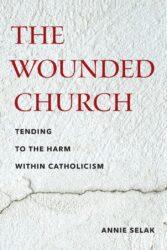
 We will begin our next book on Thursday, October 1 - parishioner Annie Selak’s The Wounded Church: Tending to the Harm within Catholicism. We’ll read Chapter One, p. 1 - 37 in the print edition, and then will continue following the schedule below. If you would like a pdf sample to begin reading before you receive your copy in the mail, email Brian Flanagan at [email protected].
Her publishers describe the book as follows:
“In The Wounded Church, theologian Annie Selak argues that the Catholic Church must confront its own injuries in order to credibly be the Church. Using a feminist framework, she develops a new ecclesiology around three wounds, racism, sexism, and clericalism, that actively harm the Body of Christ and distort its witness.
Attentive to history, pastoral practice, and lived experience, Selak shows how each wound is both inflicted by the Church and borne within the Church. She offers the resurrected body of Jesus, scarred yet no longer bleeding, as a guiding metaphor for ecclesial renewal, a body that does not deny its wounds but is transformed through them. Drawing on Karl Rahner, she grounds hope in the reign of God while insisting on concrete institutional and spiritual conversion.”
And if you’d like to read a longer review of the book, there’s one here from the National Catholic Reporter.
We’ll be reading according to the following schedule:
October 1 - Chapter One, p. 1-37
October 8 - Chapter Two, p. 38-57
October 15 - Chapters Three, p. 58-80
October 22 - Chapter Four, p. 81-115
October 29 - Chapters Five and Six, p. 116 - 148
November 5 - Chapter Seven and Afterword, p. 149-179
November 12 - Conversation with the Author
And then, later this fall, we’ll begin Gerhard Lohfink’s The Light of Faith and Reason: Israel, Jesus, and the Enlightenment.